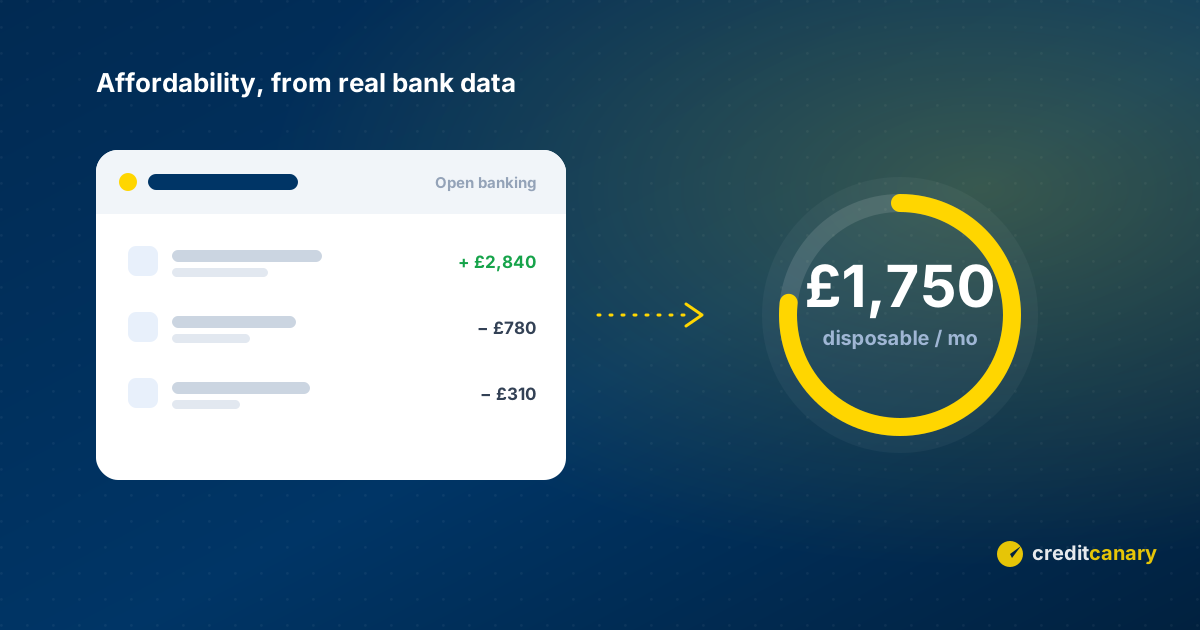
- An open banking affordability check reads real transactions to show what a customer genuinely earns and spends, rather than trusting a stated figure.
- Under Consumer Duty, affordability evidence from source makes lending decisions defensible and helps avoid foreseeable harm.
- The same consented data supports ongoing monitoring, catching signs of distress before a missed payment.
- Provider quality lives in categorisation accuracy, coverage, consent experience and regulatory standing, not the raw connection.
An affordability check answers a deceptively simple question: can this customer sustainably afford this commitment? For years the honest answer was an estimate, built on a stated income, a credit file and a bureau-modelled view of outgoings. Open banking changed that. With the customer's consent, a lender can now read the genuine money moving through an account and base the decision on what actually happens, not on what was declared.
This guide is for UK lending, credit risk and RegTech teams weighing up open banking affordability checks: what they measure, why they are more reliable than the alternatives, how they map onto Consumer Duty, and what separates a good provider from a box that simply returns transactions.
What an open banking affordability check actually measures
A raw bank feed is just a list of credits and debits. The value is in the interpretation. A good affordability check turns months of transactions into a clear picture: verified income by source and regularity, essential outgoings such as rent, utilities and existing credit commitments, discretionary spend, and the disposable income that is left once the essentials are met. From there it can surface the signals that matter for a lending decision, financial resilience, volatility in income, reliance on an overdraft, gambling activity, or the early markers of financial difficulty.
Credit Canary's Affordability Score and Income Verification are built on exactly this: categorised, enriched transaction data that confirms income and models real affordability over time, rather than at a single point.
Why it beats declared income and payslips
Declared income is a guess, and not always an honest one. Payslips are a point-in-time document that can be out of date, edited, or simply unrepresentative for anyone with variable, seasonal or self-employed earnings. Both create friction: the customer has to find and upload documents, and someone has to review them, which slows the decision and loses applicants along the way.
Reading income and outgoings directly from the bank removes both problems at once. The data is current, hard to fabricate, and covers several months, so it shows the pattern rather than a snapshot. For thin-file customers and the self-employed, where a bureau view is weakest, it is often the most reliable evidence available.
Affordability checks and Consumer Duty
Under the FCA's Consumer Duty, lenders must be able to show that their decisions rest on a reasonable understanding of the customer's circumstances, and that they act to avoid foreseeable harm. Affordability evidence taken from source is a core part of that. It makes an affordability assessment defensible in a way a stated figure never can, it reduces first-payment defaults caused by overstated income, and it helps ensure customers are not lent amounts their real income cannot sustain.
The practical test is whether you can evidence, for any given decision, what you knew about the customer's affordability and why you concluded the commitment was sustainable. Transaction-level data gives you that audit trail.
From a one-off check to ongoing monitoring
Affordability is usually assessed once, at application. But the same consented data can support a refreshed view over the life of a product, which matters most for customers whose circumstances change. A fall in income, a jump in essential costs, or the first signs of reliance on credit can be seen early, giving the lender a chance to offer support before a payment is missed. Used proportionately and on clear, renewed consent, this moves outcomes monitoring from a periodic, backward-looking exercise to something continuous. Feeding those signals back into your decisioning engine closes the loop between what you decided and what actually happened.
How to evaluate an affordability checks provider
Every provider can connect to a bank; the open banking rails are shared. The difference is in what happens to the data after the connection. When you compare providers, weigh:
- Categorisation accuracy. Income detection and expense classification are the whole game. Test them on real, messy cases, not demos.
- Coverage. How many banks and account types are supported, and how cleanly does the connection re-authenticate?
- Enrichment and signals. Beyond raw categories, does it surface affordability, income stability, resilience and risk markers you can actually decision on?
- Consent experience. A clear, fast consent journey protects conversion; a clumsy one loses the applicant at the worst moment.
- Regulatory standing. The provider should access account information under proper FCA-regulated permissions, with read-only, revocable, consent-based access.
- Fit with your stack. Affordability data is most useful when it lands in the same decisioning layer as your bureau, identity and internal data, not in a silo.
Where it fits in the lending workflow
At origination, an affordability check sharpens the decision and surfaces genuinely creditworthy applicants a thin bureau file would miss. In collections and forbearance, a refreshed view supports fair, sustainable arrangements grounded in what the customer can actually pay. Across both, the data is the same; the win is treating affordability as one continuous capability rather than a box ticked once at the start.
Frequently asked questions
What is an open banking affordability check?
It is an assessment of what a customer can sustainably afford, based on real transaction data shared with their consent through open banking, rather than on a stated income or a document. It identifies verified income, essential outgoings and the disposable income left over.
How is open banking affordability different from a credit check?
A credit check looks at how someone has handled credit in the past; an open banking affordability check looks at what is happening in their account now, their actual income and outgoings. The two are complementary, and the strongest decisions use both.
Does open banking affordability help with Consumer Duty?
Yes. Consumer Duty requires decisions to rest on a reasonable understanding of the customer and to avoid foreseeable harm. Affordability evidence taken from source gives lenders a defensible audit trail and reduces the risk of lending that a customer cannot sustain.
Can the same data be used for ongoing monitoring?
With clear, renewed consent, yes. A refreshed view of income and spending can flag early signs of financial difficulty, letting a lender offer support before a payment is missed, used proportionately and transparently.
What should you look for in an affordability API?
Categorisation and income-detection accuracy first, then bank coverage, the quality of the affordability and risk signals it returns, a clean consent journey, proper FCA-regulated access, and how well it fits into your existing decisioning stack.