On Friday the government announced that more than half a million additional workers will be able to save straight from their pay packet, with the money there whenever they need it. BT, M&S, Veolia and Home Bargains have joined the National Coalition for Workplace Savings, alongside Co-op, SUEZ, Bupa and others.
When the Coalition launched in June, its signatories employed around 400,000 people between them. Five months on, the government is counting half a million more. It is good news. But the announcement names thirteen employers and not one organisation that will hold the money. The words “credit union” do not appear.
That is not because we are absent. Credit unions are in the room. We are just not leading it, and the story of how we got here is worth telling properly, because one of the names on that list has a credit union behind it.
In November 2021, SUEZ recycling and recovery UK changed one thing about how its new starters were offered payroll savings. Instead of asking people to sign up, it enrolled them with its credit union, TransaveUK, at £40 a month unless they said no. Nest Insight ran it as a research trial. The results were stark.
Before the change, roughly one new worker in a hundred saved. Four months in, it was 48 in a hundred. The habit held for two years, and savers’ typical balances grew from about £125 at four months to more than £400 at 24.
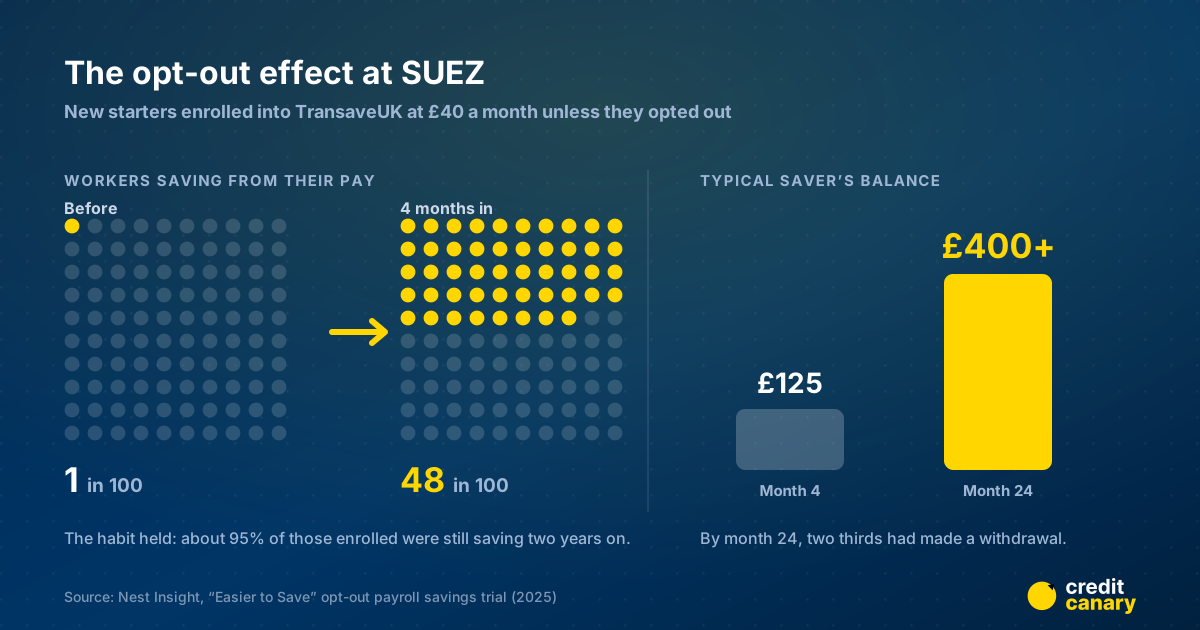
More than a third of the people surveyed said they had no savings at all before it began. And they used the money: by month 24, two thirds of savers had made a withdrawal, which is what an emergency fund is for. Almost two years on, TransaveUK had gained close to a thousand active members, and around 95% of those enrolled were still saving.
A credit union, in other words, was the provider in one of the trials that produced the evidence this whole policy now leans on.
So why did it not spread? Not because it failed.
The trial reached 2,853 workers at an employer of about 5,000, and it stayed that size for reasons that had little to do with TransaveUK. Opt-out saving ran into rules written for a world where the customer always takes an active step. A depositor is meant to acknowledge FSCS protection before the account is formed. Account terms need active agreement. Identity checks still need the employee’s involvement. Nobody had formally clarified how the scheme sat with National Minimum Wage rules, and whether it counted as a deduction from pay was a grey area. The workaround was to build it into pre-employment checks and onboarding, which stopped it reaching the existing workforce. Nest Insight’s own conclusion was that employers wanted to offer it and did not feel able to.
Some of that has since moved. In August 2025 the FCA published a statement giving employers and providers comfort that workplace savings can be run within existing rules, a move the sector welcomed, and last week the government promised a factsheet on the minimum wage question. But read the statement closely: it covers schemes people sign up to. The opt-out model, the one that took SUEZ from one saver in a hundred to 48, is still waiting for its regulatory space. Nest Insight has asked for exactly that. So should we.
And none of this was new to us in 2021. In June 1982 two BAE employees, John Geraghty and Les Walker, started collecting savings from their colleagues. That became First Rate Credit Union, whose common bond had by 2003 widened from a single site to every BAE Systems employee in Britain. The employer sits in the common bond, the money comes out of pay before the worker sees it, and the credit union holds it, FSCS protected and owned by the people saving with it. Outside the banks, the building societies and government itself, I can’t think of a more relevant party to do this.
Which leaves the uncomfortable question. If regulation is only part of the excuse, what is the rest?
Part of the answer is that while we waited, others built. Salary Finance reports 650 employer clients reaching 4.7 million UK employees. Stream, formerly Wagestream, is available to more than three million employees through over 2,000 organisations, and by August this year more than 950,000 people had saved through it. The entire credit union sector has around 2.16 million adult members. Those firms scaled payroll-linked finance on a few simple principles: integrate with payroll once, give the employer one contract, give the employee one app and one brand. Too many credit union schemes still run on manual reports and spreadsheets passed between a payroll team and a back office. That is a solvable problem, and in an AI-centric world it is solvable quickly. It makes no sense that a methodology proven in workplace lending cannot scale savings inside a credit union.
Nor is the common bond the obstacle people assume. The potential membership cap on a locality common bond is three million and is set to rise to ten. Tesco, the country’s largest private employer, has a little over 300,000 UK staff. Most employers are far, far below the threshold, and First Rate has covered a national employer under one common bond for more than twenty years.
There is a live test of all this right now. A major national employer, served for three decades by three separate credit unions, is tendering to bring all of its employees under one. Think about what that tells you. Each has spent three decades taking savings straight from that workforce’s pay. And the employer now wants one answer, not three.
That is the national employer’s view of our sector in a single procurement, and it is the right instinct. But the worst outcome would be a contest decided on loan rates and service levels, with the winner inheriting a payroll file. Payroll savings should be a key focus of that requirement: how many of that employer’s people are saving today, how the bidder would make saving the default for new starters and what they would need from the regulator to do it, and what the experience looks like on a phone at the end of a shift. If we cannot show it there, with three credit unions that have known that workforce for thirty years, it is hard to argue we should be trusted with BT or M&S.
Because what that employer is asking for is what every national employer wants, and what the sector as a whole still cannot offer: one brand, one platform, and a network of credit unions underneath. The employer signs once. The brand has to be consistent, desirable enough that people really get behind it, and built on a true understanding of the employees trusting it with their money.
It should be a CUSO, a credit union service organisation, part-owned by the credit unions it fronts, so nobody hands their members’ front door to a third party. But it should be led by people who have excelled in retail banking at scale and know how to overcome the limits that have held us back.
And the CUSO has to move first. Not government, not the trade bodies. It needs to arrive with a clear proposition, good technology, a clear call to action and market research that validates why people want to save and why that safety net matters, so that government, the wider sector and the trade bodies have something concrete to get behind. It will need funding to get over the line, and this is precisely the kind of work Fair4All Finance should be backing.
A credit union helped prove this works. The rules that held it back are only half rewritten, and nobody has more standing to finish the job. What is left to build is the thing that lets a national employer say yes.
Jim Fell is founder and CEO of Credit Canary and Vice Chair of the Credit Union Foundation.
← Back to News & Opinion