
Fair4All Finance has just finished a run of three roadshows, Manchester, Birmingham and London, gathering the sector around the next phase of the Credit Union Transformation Programme. The delegate pack shared afterwards is a good document. It is candid about the scale of the problem, honest about the disagreements surfaced in the consultation, and refreshingly clear that, in Fair4All's own words, "this is not the end of the conversation."
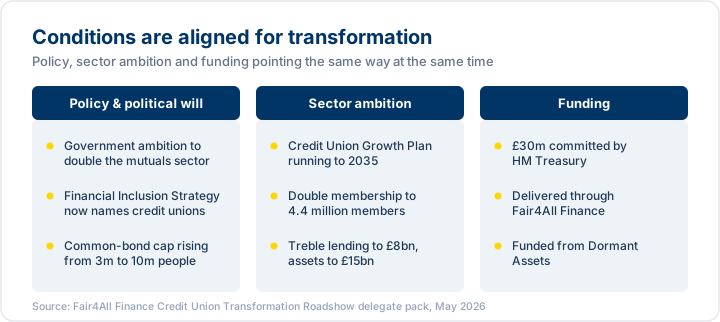
One slide in the pack is titled "Conditions are aligned for transformation." It is right.
For the first time in a long time, the politics have arrived. Rachel Reeves used her first Mansion House speech to launch the reform of credit union common-bond rules, the membership cap is rising from three million to ten million people, with new categories of membership alongside it. The government's manifesto commitment is to double the size of the co-operative and mutual sector. The Financial Inclusion Strategy names credit unions as central to widening access to affordable finance. The FCA is standing up a Mutual Societies Development Unit. And the Treasury has put £30m behind the transformation of credit unions in England, channelled through Fair4All Finance.
Add the sector's own Growth Plan, double membership to 4.4 million, treble lending to £8bn by 2035, and you have policy ambition, sector ambition and funding all pointing the same way at the same time. That alignment does not come around often. Windows like this close.
So the question is not whether the moment is real. It is. The question the pack does not quite answer is what the £30m actually buys.
The sector knows it needs to change. The debate is how.
The most useful section of the pack is NPC's independent analysis of the consultation, 54 responses from credit unions, trade bodies, tech partners and policy stakeholders. Its headline finding is that the sector broadly backs the case for transformation, and that "the main debate is about the route to change, not the need for change."
That is genuine progress. But look at what the "route" debate is actually about. Consolidation versus collaboration-first. Mergers versus CUSOs. Regional hub-and-spoke versus national infrastructure versus dual-track models. Whether to build from existing alliances or design something new.
Every one of those is a question about structure, about boxes and lines. Who owns what, who merges with whom, how the org chart is drawn.
Structure is not the binding constraint.
Here is the uncomfortable part. You can win the structural argument completely and still not move the numbers.
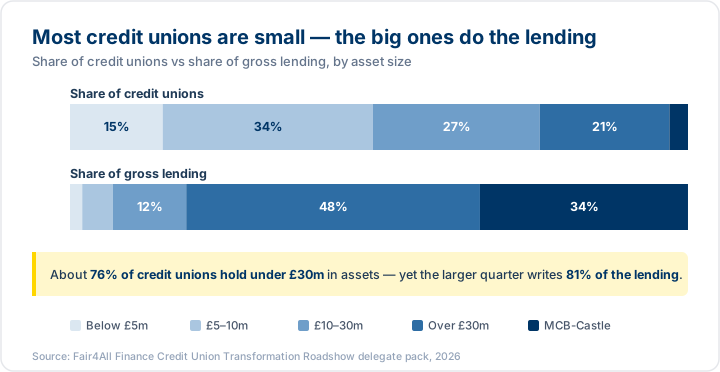
The pack's own data shows why. Roughly three-quarters of credit unions in Great Britain hold less than £30m in assets, and the larger quarter already writes 81% of the lending.
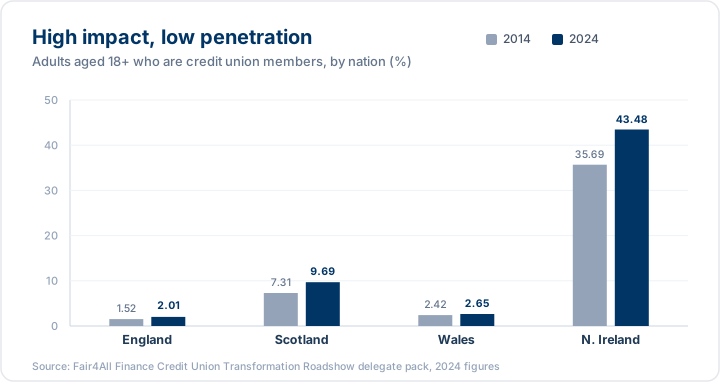
The penetration gap is stark, around 2% of adults in England are credit union members, against more than 43% in Northern Ireland. The prize, if England, Scotland and Wales caught up, is enormous: £58bn of savings and 23 million members.
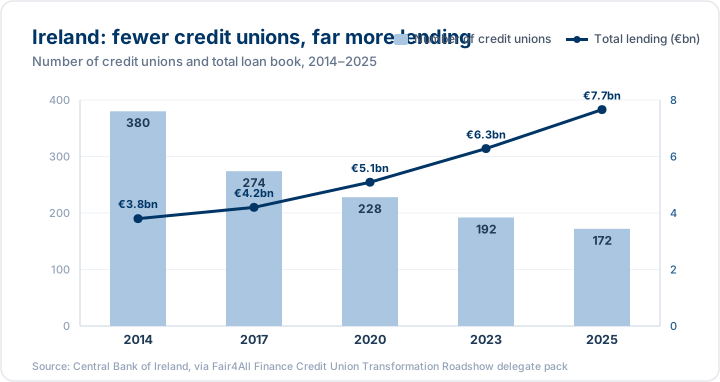
But the route there is not simply "fewer, bigger credit unions." Ireland is held up in the pack as the proof of concept, and rightly: it went from 380 credit unions to 172, grew assets by more than half and lending by 77%.
Yet the lesson New Era draws from that experience, stated plainly on their own slide, is this: "Mergers alone are not the answer, scale is critical."
Scale is not the same thing as size. You can merge sixty small credit unions into eight regional ones and, if nothing else changes, you have eight credit unions with exactly the same cost-to-serve on a £500 loan as the sixty had. The members are the same. The thin files are the same. The manual underwriting, manual outreach and manual collections are the same. You have reorganised the problem, not solved it.
I made this argument in more detail in my response to Fair4All earlier this year. Across 43 UK credit unions, £389m of member savings was sitting at high street banks rather than reaching members as loans, not because the sector lacks deposits, and increasingly not because it lacks social investment, but because the cost-to-serve of the existing operating model forces a defensive posture toward its own balance sheet. More than one in five of those credit unions had an efficiency ratio above 100%, losing money on operating cost alone, before a single bad debt was provisioned. Restructuring does not touch that.
The consultation already diagnosed the real problem.
The striking thing is that the sector has already said this, in the pack, in its own words.
NPC's fourth narrative describes "offering market-leading solutions" as "a shared challenge, requiring common rails, better data foundations, and space for implementation support." It notes that "better technology depends on better data foundations," with weak data a "structural constraint" on affordability checks, income verification and fraud prevention. And it carries a warning that ought to be on the wall of every transformation meeting: "implementation matters as much as procurement, technology can increase exclusion if poorly implemented."
That is the operating-model argument, and the sector has diagnosed it correctly. The risk is that the £30m gets spent somewhere else, on the structural debate, because that is the debate everyone is already having.
We have seen where "tech transformation" money has gone before: online application forms feeding manual underwriting queues, customer portals bolted onto legacy cores. A digitised version of the paper-and-spreadsheet model, a nicer screen on the same process. Fund that again and call it transformation, and the conditions will look just as "aligned" in 2030, with a slightly wider gap.
What the £30m has to buy.
None of this is an argument against CUSOs or shared infrastructure. The opposite. Collaborative Finance in Ireland, the Cultivate brand, is exactly the right model: four Galway credit unions in 2017 became 56 member credit unions with €8.6bn in assets and more than €200m of lending, by sharing a product, a platform, standardised terms and the operational scaffolding around them. That is what "common rails" looks like when it works.
But the thing you run on the shared rails has to be a transformed operating model, not a shared version of the manual one. The £30m should be buying end-to-end automation of the lending lifecycle: origination, underwriting, decisioning, payment and engagement, built once and run across the sector, with the cost-to-serve of a £500 thin-file loan falling by an order of magnitude rather than a few percentage points. That is the difference between a CUSO that gives sixty credit unions a shared back office, and a CUSO that gives them a back office that barely needs staffing.
Fair4All says it will be "disciplined about not spreading the £30m too thinly." Good. The discipline that matters most is spending it on the operating model, not the org chart.
Now is the time, so spend it like it.
The pack's framing is "growth with purpose, not growth at any cost." Agreed. But purpose without a viable operating model is just a slower way to run out of road.
The Irish slide that should stay with everyone who attended is the one that reads: "The time to act is before the crisis." The UK is not in the crisis Ireland faced in 2011. That is precisely the advantage, and it is an advantage that wastes away if the next two years go on drawing boxes.
Rachel Reeves has done her part. The political will is real, the legislative reform is moving, the money is committed. The conditions genuinely are aligned. What the sector and Fair4All do with the £30m now decides whether, in 2030, we are looking at a transformed credit union sector, or writing this same response to the next consultation.
Note on the sources: figures and quotations above are drawn from the Fair4All Finance Credit Union Transformation Roadshow delegate pack (London, 12 May 2026), including NPC's independent analysis of the transformation consultation and New Era Support Services' account of the Irish transformation. UK credit union balance-sheet figures are from the analysis in our earlier response to Fair4All Finance.
← Back to News & Opinion