
Private credit has spent a decade as one of the great growth stories in finance. It is now learning a harder lesson, and it is one every UK consumer lender should be reading closely.
In its 2026 Global Private Markets Report, McKinsey describes an asset class in transition. After years defined by abundant capital and remarkable consistency, private credit “is becoming less about deploying capital at pace, and more about deploying it with precision.” It’s a shift that reaches well beyond institutional credit funds. The same logic applies to anyone whose business is deciding who to lend to, including UK consumer lenders.
The commoditisation of capital
The mechanics behind McKinsey’s warning are worth sitting with. When money is plentiful and competition for borrowers is fierce, the price of lending falls and the discipline of lending slips. Both are now visibly happening.
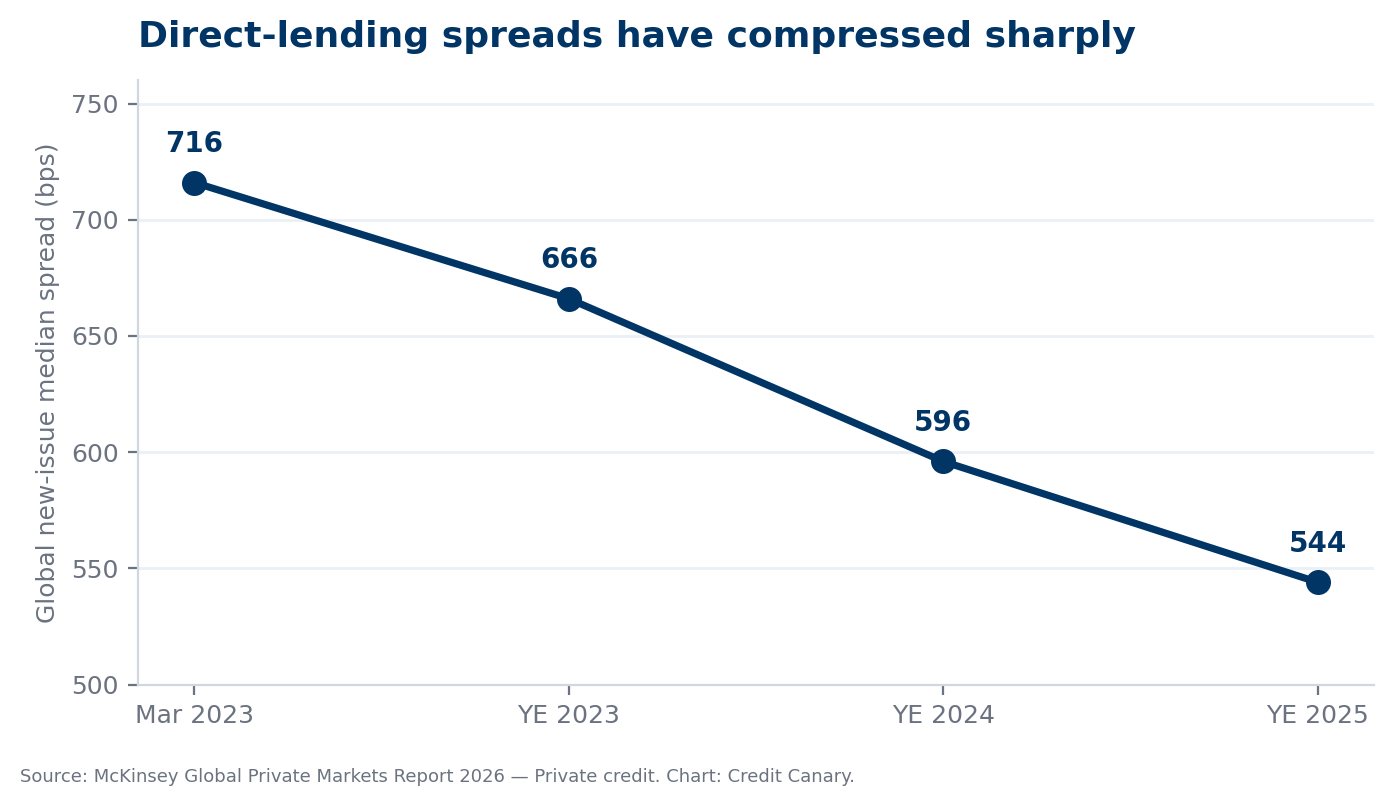
Direct-lending spreads, the margin lenders earn for the risk they take, have compressed from 716 basis points in early 2023 to 544 by the end of 2025. All-in new-issue yields fell from 10.5% to roughly 9.3% in a single year. Around $500 billion of dry powder is competing for a shrinking pool of deals, with US direct-lending volume down roughly 10% and deal count down 16%.
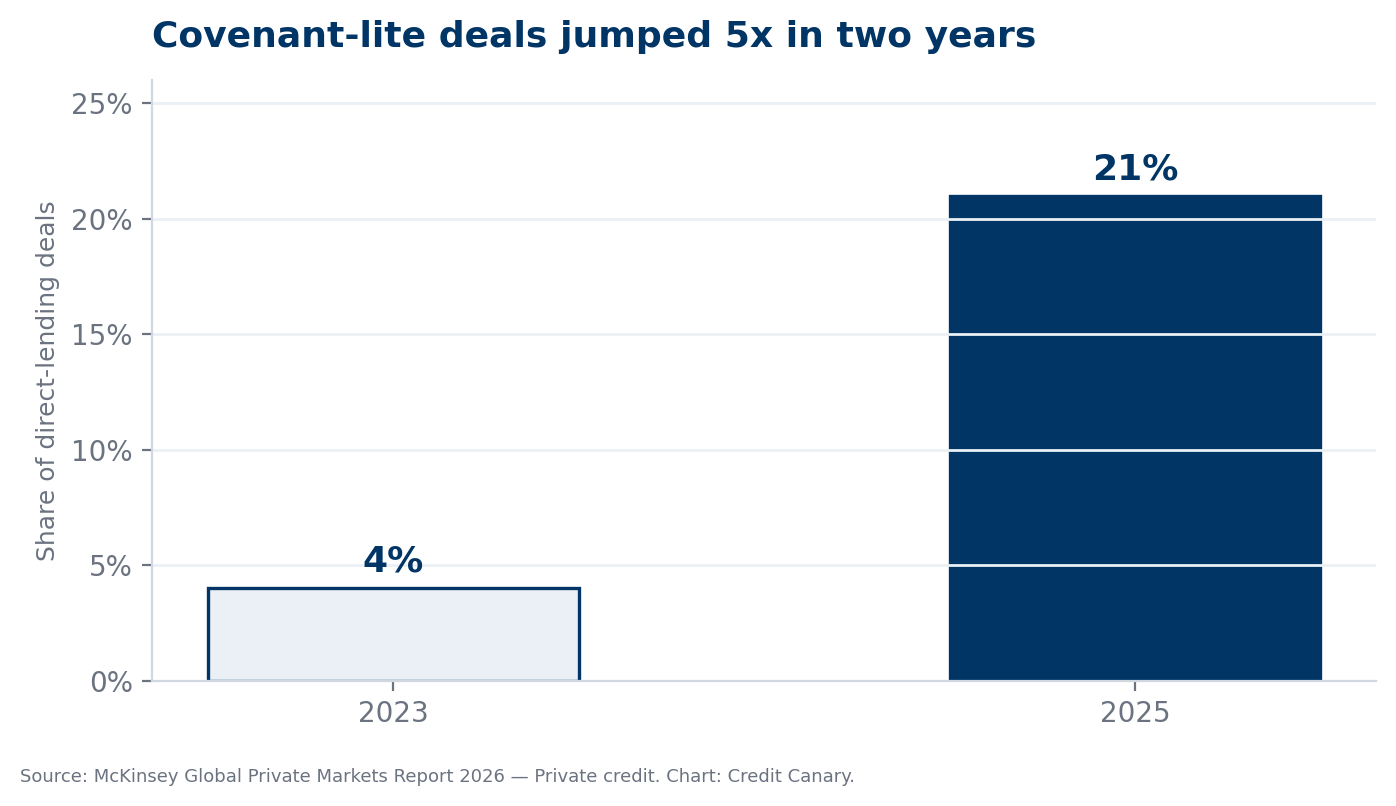
As margins thin, so do protections. Covenant-lite deals, loans with weaker safeguards for the lender, rose from just 4% of direct-lending transactions in 2023 to 21% in 2025. When capital chases borrowers, terms drift in the borrower’s favour and underwriting standards quietly erode. That is exactly the environment in which mistakes are made.
The consequences are beginning to surface. Fitch has flagged private credit default rates rising to record levels, and “bad PIK” interest deferred mid-loan because a borrower is under strain, rather than structured that way at the outset, has climbed to nearly triple its 2021 share. EY’s assessment of the market is blunt: dispersion matters more than defaults. The story isn’t the average outcome; it’s the widening gap between the lenders who underwrote well and the ones who didn’t.
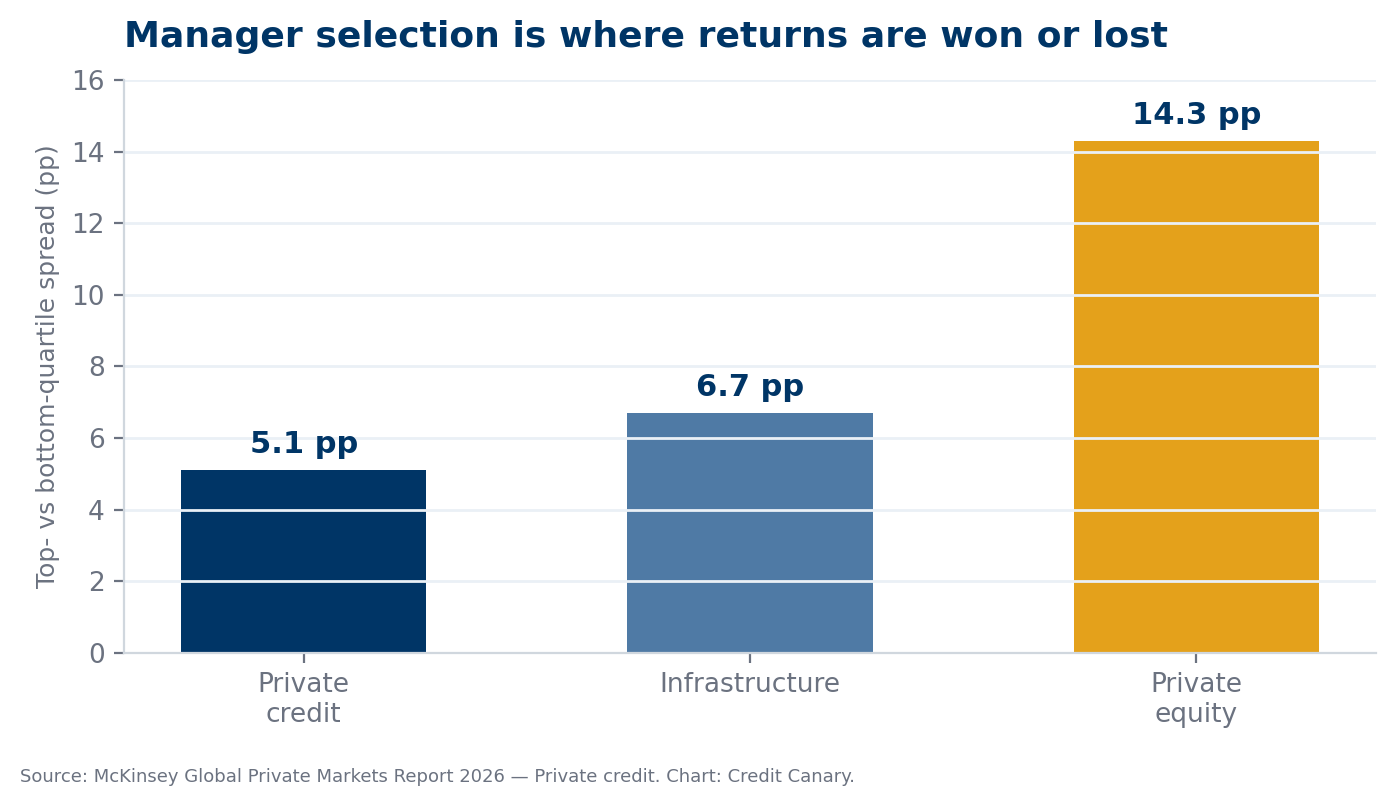
McKinsey’s data makes the same point. Return dispersion in private credit, the spread between top- and bottom-quartile managers, is still the narrowest of the major private asset classes. But it widens sharply as lenders move up the risk curve, and, as the report puts it, “manager selection becomes increasingly critical.” Translated: when easy returns disappear, the difference between a good lender and a poor one stops being a rounding error and becomes the whole result.
The real vulnerability is visibility
Here is the part of the debate that gets too little attention. When the Financial Stability Board and the IMF examined private credit’s risks, the vulnerability they kept returning to wasn’t leverage or liquidity in the first instance, it was data. Valuations are infrequent, credit quality is hard to observe, borrowers often lack public ratings, and the interconnections are opaque. Their core recommendation is more and better data, for a simple reason: you cannot manage what you cannot see.
That is the thread that runs from a multi-billion-dollar credit fund all the way down to a single consumer loan. The lenders who navigate this next phase well, at any scale, will be the ones who build genuine visibility into the borrower at origination, at the moment the decision is still reversible and the price is still being set. McKinsey says the best-positioned platforms “maintain underwriting discipline under competitive pressure.” Discipline under pressure is not willpower. It is a data capability. You only hold the line on a marginal deal when you can see clearly enough to know it’s marginal.
The same lesson is arriving in UK consumer credit, as regulation
For UK consumer lenders, this stops being a competitive nicety and becomes a regulatory floor. The institutional market is discovering through losses that origination-stage data quality is the moat. UK regulation is hard-coding the identical principle into the rulebook.
Consumer Duty already requires lenders to demonstrate, with evidence, that lending is affordable and delivers good outcomes. Open Banking now has more than 16 million active users, giving lenders consented, real-time visibility into income and expenditure that a bureau snapshot can’t match. The FCA’s Open Finance roadmap extends that consented-data model across the credit lifecycle through 2030. And from 15 July 2026, Buy Now Pay Later and Deferred Payment Credit enter the FCA perimeter for the first time, bringing a fast-growing slice of consumer lending under the same affordability expectations.
The direction is unambiguous. Lenders who treat rich origination data as a compliance cost will spend the next five years retrofitting. Those who treat it as their core advantage will turn better visibility into better lending, and the evidence that they can is already here.
The proof is already on the ground
Wherever UK lenders put quality data at the front of the journey, the same pattern appears: they lend more, lend more safely, and serve members and customers better. The mechanism is best understood as a funnel. The width at the top, the lender’s risk appetite, stays fixed. What changes is how much good business survives the journey to approval.
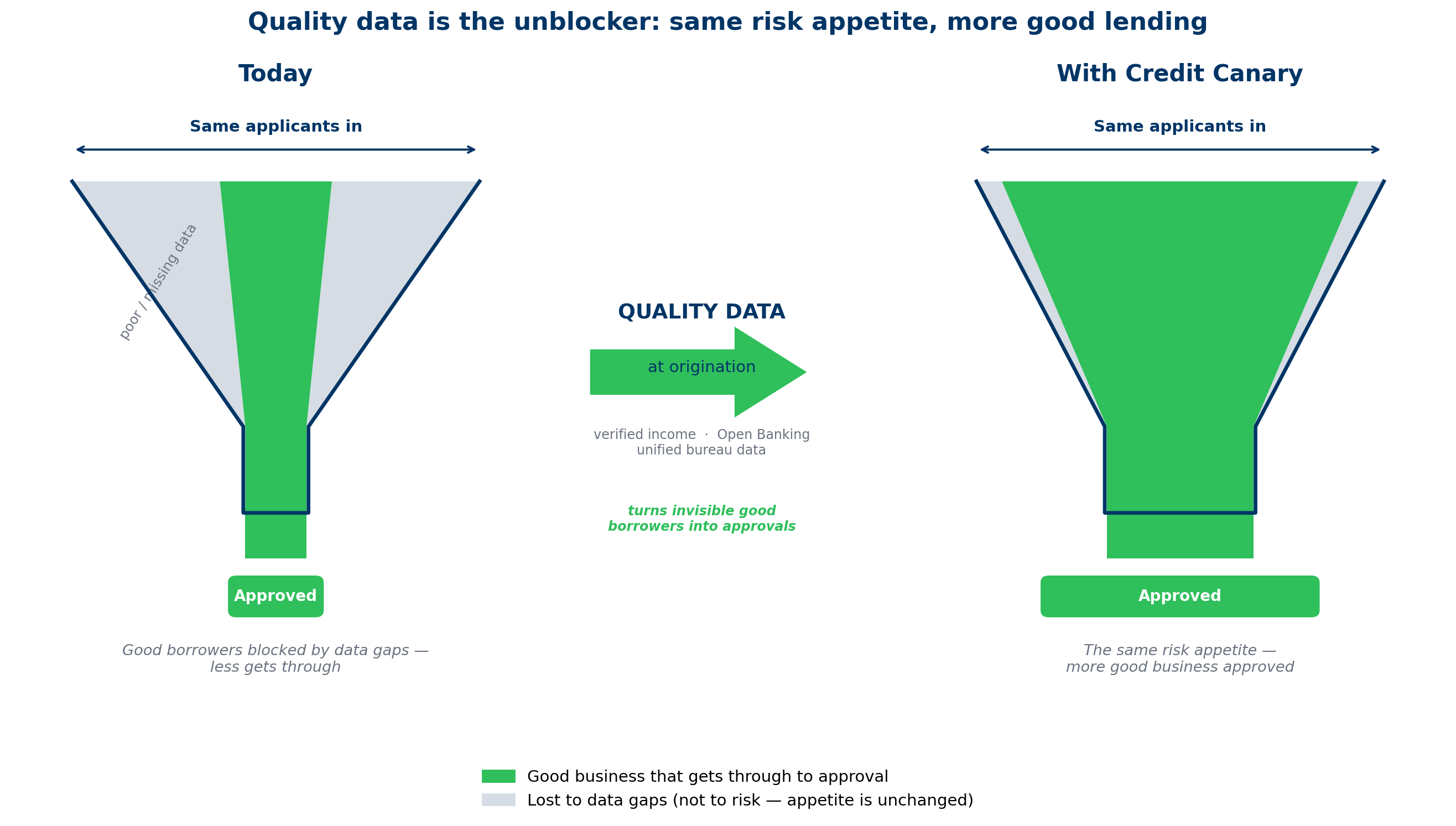
Today, viable borrowers are lost along the way, not because they fall outside risk appetite, but because of a “data gap” at origination (missing or unverified information) and a “data compatibility gap” in underwriting (fragmented systems that can’t bring the full picture together). Enriched, unified data at origination closes those gaps, so far more of the same-risk applicants convert through to approval. The funnel widens; the risk appetite doesn’t.
A leading UK retail bank set out to give borderline loan applicants a fairer hearing. Instead of asking declined customers to post income documents and hoping they’d respond, its unsecured lending team began verifying income and affordability directly through Open Banking at the point of decision, using an end-of-day balances model now validated across more than 20 banks. The result: 40% of previously declined applications were responsibly approved, with a fourfold rise in customer response rates. These weren’t riskier loans. They were the same customers, seen more clearly. Better data at origination didn’t loosen standards, it revealed good lending that had been invisible.
GMB Credit Union rebuilt origination around Open Banking pre-fill, automated affordability and tailored risk rules, and delivered a 28% increase in new lending in a single year, with origination costs cut by 50% and 13,000 hours of manual admin removed. No extra marketing, no extra headcount. Just capacity unlocked by cleaner data flowing through a sharper decision.
Where the next cycle is won
The private credit story and the UK consumer credit story are the same story told at different scales. Capital has become the commodity. Insight at origination has become the differentiator. McKinsey is telling institutional lenders that precision now beats pace. UK regulators are telling consumer lenders the same thing in the language of Consumer Duty and Open Finance.
The lenders who win the next decade won’t be the ones who raised the most or lent the fastest. They’ll be the ones who, at the exact moment of decision, saw the borrower most clearly. Everything downstream, margins, defaults, redemptions, outcomes, is set in that instant. The edge was always at origination. Now the data finally exists to seize it. The only question is who moves first.
Chart data: McKinsey Global Private Markets Report 2026, “Private credit in 2025: A maturing industry navigates change” (Kazimi, Spivey & Teichner). Additional sources: Financial Stability Board, IMF Global Financial Stability Report, Fitch Ratings, EY and the FCA. Case studies: Credit Canary.
← Back to News & Opinion